By the time the final night of the retreat had arrived we had all been through so much. We struggled both physically and mentally, we dealt with back pain, frustration, feelings of inadequacy, battling the urge to run, discomfort. Some of us had epiphanies and moments of supreme connection we had never before realized. I had a 30 minute zazen period where I had such creative energy come through me that I had to return to my room and write down some of the ideas down before I forgot them. Much of the blogging that I've done about this retreat came out of that zazen period. Some of us had life-changing moments on our little square 3' x 2' zabuton cushions all alone and yet surrounded by others that were having their own epiphanies and battling their demons in the loneliness of their zabutons, surrounded by the rest of us. And all of this roiled beneath the veneer of silence and tranquility that is 60 Buddhas sitting silently in a Zendo.
The final night began with a period of zazen. We didn't know what to expect. After we had been sitting for about 15 minutes in complete silence, we heard the haunting sounds of a Japanese chakuhachi emerge from the front of the Zendo. The first note began so softly that it seemed to just insinuate itself into my consciousness. I closed my eyes and drank in the mournful sounds of this lovely bamboo instrument, with it's pitches bending wildly, wielded by a musician that understood it's power to speak, and from the music he played, I clearly knew he had been on the same retreat as I had, and walked the same stark morning kinhin walk that I did. As he is playing, the wind outside the building is intermittently howling and rattling the windows. After 7 minutes or so, he ends his moving concierto as quietly as he began.
Again we sit. There is nothing but the wind outside the strong cinderblock walls of our building. And then maybe 5 minutes we hear the single "ding" of the hanging bronze umpan plate. It is a clear resonant sound that is allowed to die off. Silence.
Ten seconds pass and then from another direction we hear a metal gong being struck. It's sound is lower than that of the umpan and is also allowed to fade away into silence.
Then we hear a the hollow high pitched "tuk!" of an wooden block from the same direction.
Silence.
A small bell is rung in another direction. It's sound dies away. There is silence. We hear the wind outside.
From somewhere else the low, quick thump of a hokku or bass drum breaks the silence. No wind this time, just silence.
I wonder what the next sound will be and where it will come from.
A more sonorous larger bell from yet another corner of the zendo speaks it's deep voice before dying off into silence.
Then it all begins again, and each silence is imperceptibly shorter. And shorter again. This carol of the bells slowly picks up speed spinning clockwise around the room as each sound comes faster and faster. I notice my body begin to sway. Soon a frenzied carousel of percussion and resonance dances wildly around and through us. And then when all the sounds are piling up on top of each other it abruptly stops.
Silence.
The silence becomes louder and has a resonance of its own.
"Ding ))))))))))" from the bronze umpan.
And it's done.
Showing posts with label meditation. Show all posts
Showing posts with label meditation. Show all posts
Saturday, January 3, 2009

Morning kinhin - Zen Retreat part 5 -- (read parts in forward numerical order)
As I had mentioned in part 1 of these Zen Retreat posts, there would be a single defining event that would occur on the very last full day of this retreat that not one person would have ever anticipated, and that would change all of us forever. Well, perhaps that's not entirely accurate. There was one person that could have had a vague idea of the events to come, but I can't be entirely sure, and besides, I am getting way ahead of myself.
After retrieving my pants and bundling up, I joined the outside walking meditation line. The retreat center that the Zen group had rented out was run by Catholic nuns and was situated on a very nice campus that was surrounded by woods and streams and fields. There were houses in the neighborhood of the center, to be sure, but most were on large plots of land and nestled in and around the natural elements rather and were rather unobtrusive and almost part of the natural setting. On a sunny spring day, this would be the most inviting and idyllic New England setting. We walked off the property and onto the back country road well before the sun had even thought of coming up. Even in this darkness the you could see a dark ominous glow from the low-hanging thick cloud cover if you bothered to look up. On both sides of the narrow and hilly road, the land was thick with tall barren trees reaching out with leafless branches rattling from the cold winds gusting without apology through the skeletal forest. Some of the few remaining dead leaves would blow along the road, as if to accentuate the loneliness. Our boots crunched through isolated patches of ice and snow as we climbed a steep hill. As the icy wind stung my skin, I looked at the collection of sleeping trees and thought about how it would be to be a traveler through this very place in the days before any civilized structures were ever built here. It would be an easy place to die. It was a beautiful walk.
Later that day one of the Zen teachers commented about how wonderfully unapologetic nature is. Even in the deadness of winter, with the trees bare and the winds howling and hurtful, there is beauty in the starkness. Nature doesn't come with signs saying, "Pardon our appearance, we are redecorating for the spring." Oh, no. It is what it is. And that was the lesson.
After retrieving my pants and bundling up, I joined the outside walking meditation line. The retreat center that the Zen group had rented out was run by Catholic nuns and was situated on a very nice campus that was surrounded by woods and streams and fields. There were houses in the neighborhood of the center, to be sure, but most were on large plots of land and nestled in and around the natural elements rather and were rather unobtrusive and almost part of the natural setting. On a sunny spring day, this would be the most inviting and idyllic New England setting. We walked off the property and onto the back country road well before the sun had even thought of coming up. Even in this darkness the you could see a dark ominous glow from the low-hanging thick cloud cover if you bothered to look up. On both sides of the narrow and hilly road, the land was thick with tall barren trees reaching out with leafless branches rattling from the cold winds gusting without apology through the skeletal forest. Some of the few remaining dead leaves would blow along the road, as if to accentuate the loneliness. Our boots crunched through isolated patches of ice and snow as we climbed a steep hill. As the icy wind stung my skin, I looked at the collection of sleeping trees
 and thought about how it would be to be a traveler through this very place in the days before any civilized structures were ever built here. It would be an easy place to die. It was a beautiful walk.
Later that day one of the Zen teachers commented about how wonderfully unapologetic nature is. Even in the deadness of winter, with the trees bare and the winds howling and hurtful, there is beauty in the starkness. Nature doesn't come with signs saying, "Pardon our appearance, we are redecorating for the spring." Oh, no. It is what it is. And that was the lesson.
Wednesday, January 2, 2008
My first post
Ok...so I have wanted to create a blog for a while, and the New Year seemed as good a time as any to begin. I spent the time between Christmas and New Years in a Zen Buddhist silent meditation retreat. The way I got to such a thing is that about 3 months ago I was looking for places to learn meditation. Through word of mouth I ended up at The Village Zendo in Soho, in NYC, sitting counting my breaths a couple evenings per week. My reason in doing this is to clear my mind of all the thoughts that are constantly banging around up there, in the hopes that it will help me get through some of the things that stop me from progressing with my vocal lessons.
So after a 2.5 hour train ride and a $45 taxi ride, I find myself in this beautiful area of rural Connecticut in a large dorm building run by Catholic nuns, that has been rented out by the Zendo for their week-long annual winter retreat. As a par ticipant you are expected to remain silent, with your eyes at a downward 45 degrees the entire week. I was assigned a room on the 4th floor with a silent roommate, who I learned later was a 40-something Latin teacher for a charter school in MA. Over the next 5 days (I arrived 2 days into the retreat) I spent much of my waking hours (5:45am to 9:30pm) sitting on a round cushion on a 2 foot by 2 foot mat, staring at a heater vent and counting my breaths from 1 to 10 and then back again, trying not to become distracted by random thoughts. I found this extremely difficult because my back was sore from something I had done before I had arrived. The object of the seated meditation was to sit absolutely still, not to fidget, which was exactly what I was doing. I was frustrated.
And then there were all the Buddhist services and liturgy that I had never seen or expected. I wasn't too keen on all of the bowing and the chanting in Sanskrit and Japanese, but it was harmless and after speaking to one of the Zen teachers in "Interview" I found that even she wasn't all that keen on the ritual, but that the meditation took her where she needed to go and so she looked past all the other stuff. That sounded fair.
The food was all vegetarian, there was plenty of it, and mostly it was good. I was assigned to the daily task of washing dishes and cleaning the lunchroom every day after the mid-day meal, which was the only time I got to talk with other people, and so it was welcomed. They call it "work practice" which was an opportunity to practice a meditative state while wiping bean sprout tofu terriaki off of someone else's half eaten plate...but always in a "mindful" way. Sounds like Buddhist bullshit to me.
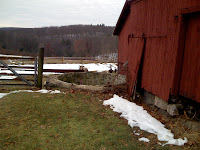
The countryside surrounding the retreat site was beautiful and between my long walks every day and the outside walking meditations that we did, I was able to fully appreciate the beauty of the snowy New England Countryside.
About 3 days into the retreat my back was less bothersome and I actually managed to sit through my meditations with less and less thoughts intruding, and when they did they intrude, they didn't really take hold. It was exciting because that has been my goal all along, to quiet the mind. My favorite "practice" time was the first meditation in the morning, at 5:45am when the world was still dark and quiet. It seemed a sacred time.
Finally on New Years Eve, a service involving the ringing of a very large bronze bowl, sounding somewhat like a sonorous gong, 108 times. This continuous ringing experienced by what was now a relatively quiet mind was quite pervading, with the sound surrounding you, going through you and being a part of you all at the same time. I think I achieved a Buddha moment listening to that ringing. After that service, all of the participants (about 60 of us) got to share for the first time that week. It was then that we got to look at everyone else and listen to their experiences and find out who we all were. I think that everyone was profoundly affected by their experience. I know I was.
So after a 2.5 hour train ride and a $45 taxi ride, I find myself in this beautiful area of rural Connecticut in a large dorm building run by Catholic nuns, that has been rented out by the Zendo for their week-long annual winter retreat. As a par
 ticipant you are expected to remain silent, with your eyes at a downward 45 degrees the entire week. I was assigned a room on the 4th floor with a silent roommate, who I learned later was a 40-something Latin teacher for a charter school in MA. Over the next 5 days (I arrived 2 days into the retreat) I spent much of my waking hours (5:45am to 9:30pm) sitting on a round cushion on a 2 foot by 2 foot mat, staring at a heater vent and counting my breaths from 1 to 10 and then back again, trying not to become distracted by random thoughts. I found this extremely difficult because my back was sore from something I had done before I had arrived. The object of the seated meditation was to sit absolutely still, not to fidget, which was exactly what I was doing. I was frustrated.
And then there were all the Buddhist services and liturgy that I had never seen or expected. I wasn't too keen on all of the bowing and the chanting in Sanskrit and Japanese, but it was harmless and after speaking to one of the Zen teachers in "Interview" I found that even she wasn't all that keen on the ritual, but that the meditation took her where she needed to go and so she looked past all the other stuff. That sounded fair.
The food was all vegetarian, there was plenty of it, and mostly it was good. I was assigned to the daily task of washing dishes and cleaning the lunchroom every day after the mid-day meal, which was the only time I got to talk with other people, and so it was welcomed. They call it "work practice" which was an opportunity to practice a meditative state while wiping bean sprout tofu terriaki off of someone else's half eaten plate...but always in a "mindful" way. Sounds like Buddhist bullshit to me.

The countryside surrounding the retreat site was beautiful and between my long walks every day and the outside walking meditations that we did, I was able to fully appreciate the beauty of the snowy New England Countryside.
About 3 days into the retreat my back was less bothersome and I actually managed to sit through my meditations with less and less thoughts intruding, and when they did they intrude, they didn't really take hold. It was exciting because that has been my goal all along, to quiet the mind. My favorite "practice" time was the first meditation in the morning, at 5:45am when the world was still dark and quiet. It seemed a sacred time.
Finally on New Years Eve, a service involving the ringing of a very large bronze bowl, sounding somewhat like a sonorous gong, 108 times. This continuous ringing experienced by what was now a relatively quiet mind was quite pervading, with the sound surrounding you, going through you and being a part of you all at the same time. I think I achieved a Buddha moment listening to that ringing. After that service, all of the participants (about 60 of us) got to share for the first time that week. It was then that we got to look at everyone else and listen to their experiences and find out who we all were. I think that everyone was profoundly affected by their experience. I know I was.
Subscribe to:
Posts (Atom)
